


Introduction
Implementing an ERP system can transform how a business operates, streamlining workflows, reducing costs, and improving decision-making. However, many companies face challenges during ERP implementation that lead to delays, budget overruns, and low user adoption. In this blog, we’ll explore the 10 most common ERP implementation mistakes and provide actionable tips on how to avoid them for a successful ERP journey.
1. Lack of Clear Goals and Objectives
Mistake: Companies start ERP projects without defining measurable business goals.
Solution: Clearly outline what you want to achieve—such as improving inventory accuracy, automating finance, or enhancing customer service.
2. Choosing the Wrong ERP Vendor
Mistake: Selecting an ERP software without considering scalability, industry fit, or support.
Solution: Research multiple vendors, request demos, and choose one that aligns with your business processes and future growth.
3. Underestimating Total Costs
Mistake: Only budgeting for software licenses and ignoring costs like training, customization, and ongoing support.
Solution: Plan a realistic ERP budget that covers all phases—implementation, integration, and maintenance.
4. Inadequate Project Management
Mistake: Lack of leadership and accountability leads to delays.
Solution: Assign a dedicated project manager and create a clear roadmap with timelines and milestones.
5. Poor Data Migration Strategy
Mistake: Migrating inaccurate or duplicate data causes issues in the new system.
Solution: Cleanse, validate, and test your data before migration to ensure accuracy.
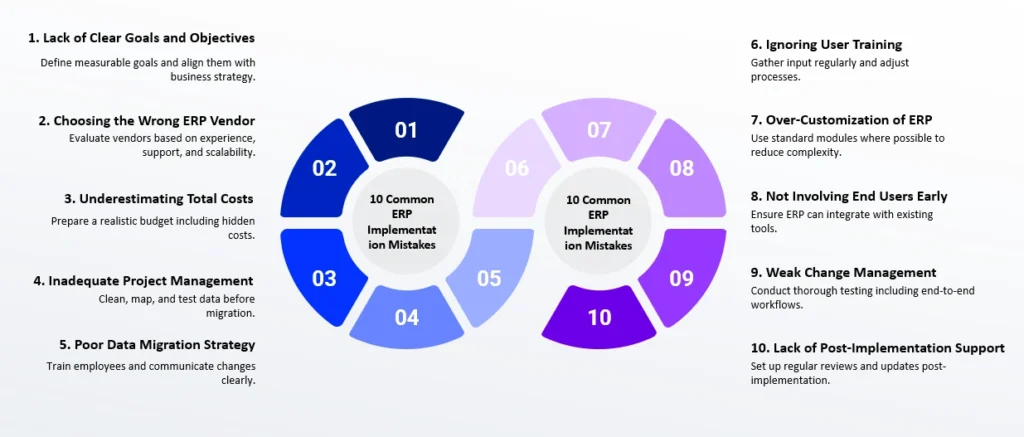
6. Ignoring User Training
Mistake: Employees resist ERP adoption due to insufficient training.
Solution: Provide role-based ERP training, workshops, and continuous support to increase user confidence.
7. Over-Customization of ERP
Mistake: Excessive customization makes the ERP complex, costly, and difficult to upgrade.
Solution: Stick to standard features and only customize where absolutely necessary.
8. Not Involving End Users Early
Mistake: Leaving employees out of the ERP selection and design process.
Solution: Engage key users early, gather feedback, and make them part of the ERP decision-making journey.
9. Weak Change Management
Mistake: Employees resist change when not prepared for new workflows.
Solution: Communicate benefits clearly, involve leadership, and provide continuous support.
10. Lack of Post-Implementation Support
Mistake: Thinking the job is done once ERP goes live.
Solution: Establish a support system, regular updates, and performance reviews to ensure long-term success.
Conclusion
ERP implementation is a complex process, but avoiding these 10 common ERP implementation mistakes can make the journey smoother and more successful. With the right planning, vendor selection, training, and support, businesses can maximize their ERP investment and drive digital transformation.
Looking for expert ERP implementation in Nagpur, India? Connect with Rhizome ERP Solutions for consultation, demo, and end-to-end ERP support.
- Contact No.: +91 9876543210
- Email: erp@rhizome.in
- Find Us in Nagpur


